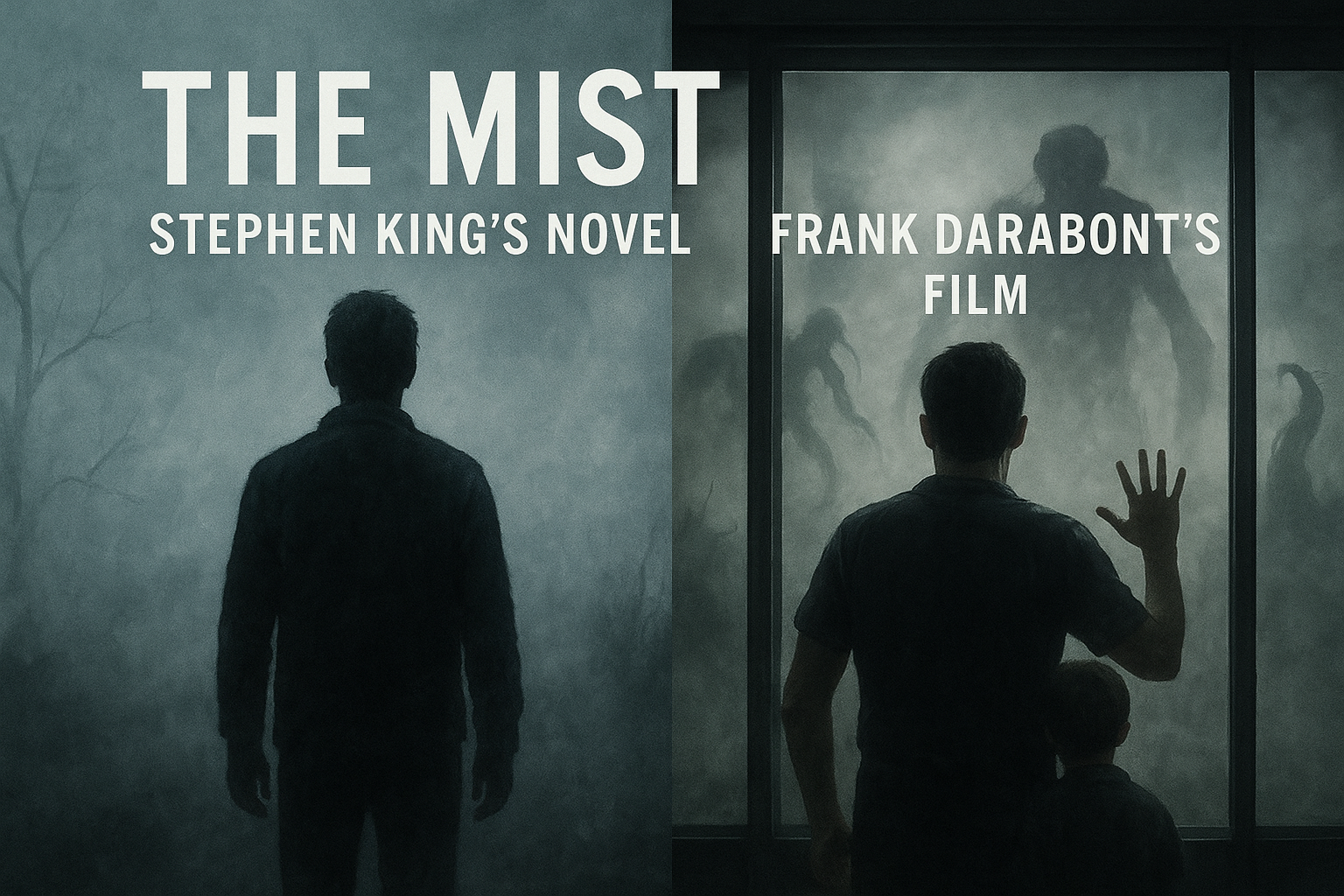
Stephen King’s The Mist (1980) and Frank Darabont’s film adaptation The Mist (2007) share a chilling premise: a small Maine town swallowed by a mysterious fog filled with nightmarish creatures. Although the core story remains similar, the tone, themes, characters, and especially the ending differ dramatically between the two versions.
Story Premise and Setting
Both the novella and the film center around David Drayton, his son Billy, and a group of townspeople trapped in a supermarket as a supernatural mist rolls in. Darabont’s film is widely considered one of the most faithful adaptations of King’s work.
Similarities in Setup
- Small-town Maine setting
- Mist filled with monstrous creatures
- Survivors trapped in a supermarket
- Rising tension between rational and irrational responses
Themes: Fear, Faith, and the Collapse of Society
Themes in Stephen King’s Novella
King’s version focuses heavily on psychological horror, exploring how fragile civilization becomes in the face of the unknown.
Key themes include:
- Breakdown of societal norms
- Ambiguity and uncertainty
- Moral dilemmas under pressure
- Cosmic horror and the unknowable
Themes in Frank Darabont’s Film
Darabont amplifies the social and religious aspects of the story, especially through the character of Mrs. Carmody.
Film themes include:
- Religious extremism
- Mob mentality
- Fear-driven decision making
- The tragedy of misunderstanding and panic
Characters and Their Portrayals
David Drayton
- Novel: A grounded, introspective narrator.
- Film: More emotionally expressive, with a more intense arc driven by the film’s dramatic conclusion.
Mrs. Carmody
- Novel: A dangerous but somewhat grounded zealot.
- Film: Elevated into a near-apocalyptic prophet figure. Marcia Gay Harden’s performance heightens her menace and influence.
Supporting Characters
The film expands or reinterprets several characters, such as:
- The soldiers whose subplot ties more directly to the cause of the mist
- Store employees and townspeople who represent diverse responses to fear
- New or enlarged roles that add tension and conflict
Monsters, Mood, and the Tone of Horror
Horror in King’s Novella
The creatures lurking in the mist have a Lovecraftian feel—immense, ancient, and barely understandable. Their descriptions leave much to the imagination, enhancing dread.
Horror in Darabont’s Film
The film uses CGI to bring King’s creatures to life:
- Giant tentacled beasts
- Insect-like monstrosities
- Mammoth creatures towering above the mist
While the visual clarity removes some of the unknown, it adds action, spectacle, and visceral terror.
The Most Significant Difference: The Ending
The Novel’s Ending
King concludes the story with uncertainty. David and a few survivors escape the supermarket, traveling into the mist without any guarantee of safety. A possible radio signal suggests hope but remains unconfirmed.
The ambiguity emphasizes the theme of cosmic horror.
The Film’s Ending
The film’s ending is drastically different and famously shocking.
Without spoiling details for new viewers, the movie closes with:
- A devastating decision made in despair
- A cruel twist of fate
- A sudden appearance of hope far too late
Stephen King himself praised Darabont’s ending, calling it “a bold stroke.”
Which Version Is Better?
Why You Might Prefer the Novel
- Ambiguous, open-ended finale
- Psychological and cosmic horror
- Narrative driven by internal tension rather than action
Why You Might Prefer the Film
- Strong emotional impact
- Heightened drama and character conflict
- A definitive, unforgettable ending
- Social messages conveyed more clearly
Both versions succeed in different ways: the novella whispers its terror, while the film delivers a cinematic scream.
Final Thoughts
Stephen King and Frank Darabont provide two haunting interpretations of The Mist. King’s novella focuses on ambiguity, psychology, and the horrors of the unknown, while the film emphasizes emotional devastation, religious extremism, and societal collapse. Together, they offer a fascinating study of how one story can be transformed across mediums while maintaining its chilling core.